A Dish That Refuses Simplicity
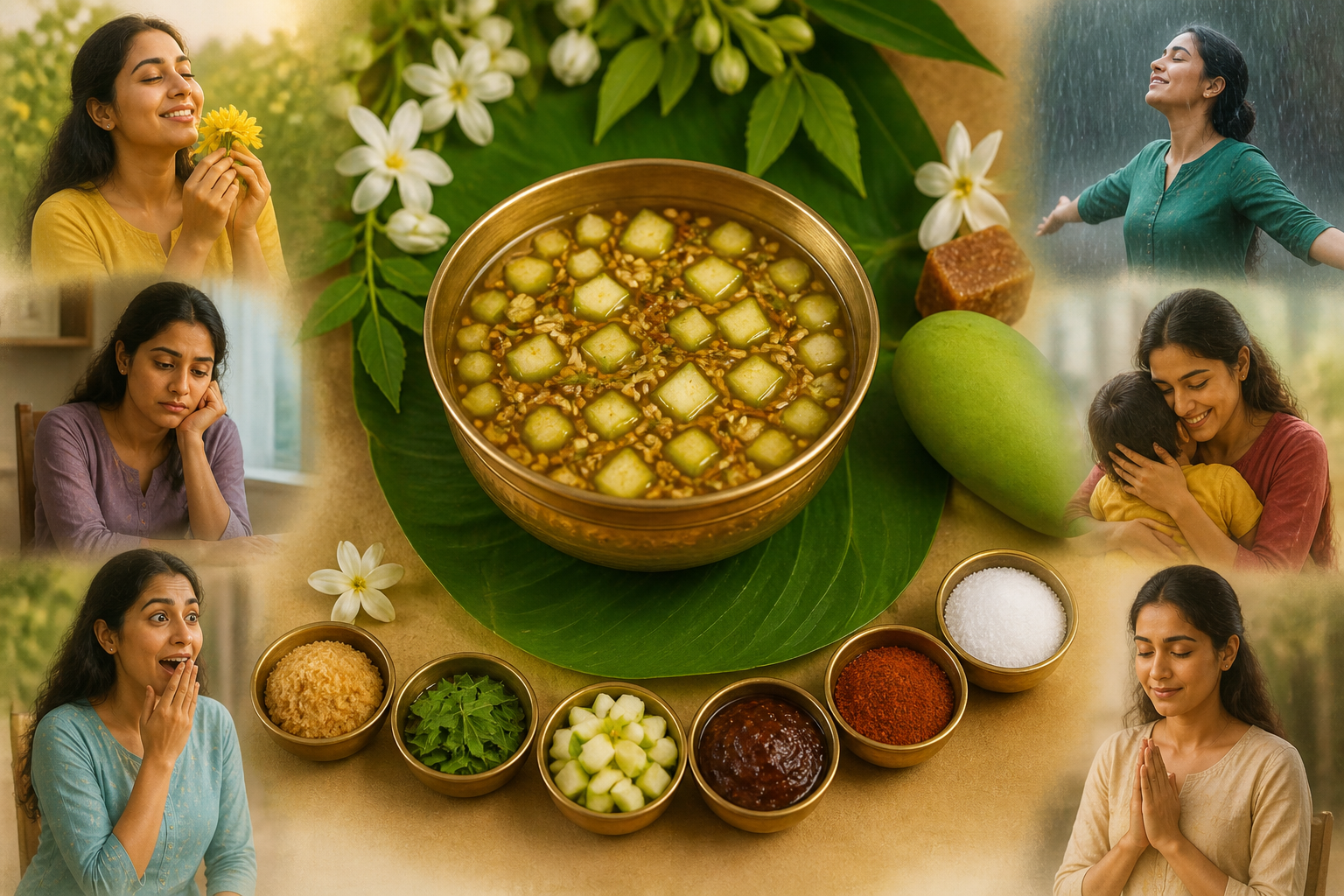
Every year on Ugadi, a small bowl of Ugadi Pachadi appears—simple, almost unassuming. Yet inside it is a deliberate combination: sweet, sour, salty, bitter, pungent, and astringent. At first glance, it feels like a culinary oddity. Why mix everything? Why not make it just sweet?
Because the dish is not trying to please your tongue. It is trying to correct your expectations of life.
Each taste mirrors a basic human emotion—not the polished, socially acceptable version of feelings, but the core set: happiness, sadness, anger, fear, disgust, and surprise. Together, they form a complete emotional system. Separately, they are uncomfortable. But so is truth when taken in fragments.
—
Sweetness and the Illusion of a Happiness-Only Life
Sweetness represents happiness—the one emotion people rarely question. Joy, love, success, relief. It is what we pursue, optimize for, and publicly display. If life were editable, most people would select only this taste.
But a life engineered for constant happiness quickly becomes fragile. Without contrast, happiness loses intensity. Without difficulty, it loses meaning. What begins as a goal turns into dependency.
—
Bitterness and the Depth of Sadness
Bitterness corresponds to sadness—the emotion people resist but inevitably encounter. It is the heaviness of loss, the quiet weight of unmet expectations.
Like a bitter taste that lingers, sadness slows you down. It forces reflection. It makes you confront what mattered enough to hurt. Without it, nothing deepens. Life remains surface-level, untouched by meaning.
—
Pungency and the Power of Anger
The sharp heat of pungency mirrors anger—intense, activating, often misunderstood. Anger is not simply aggression; it is information. It signals violation, injustice, or misalignment.
When acknowledged properly, anger clarifies boundaries and drives change. When denied or suppressed, it distorts into resentment or passive hostility. Like spice, it is not meant to dominate—but it is essential.
—
Astringency and the Precision of Fear
Astringency creates a tightening, drying sensation—much like fear constricts the mind and body. Fear is often labeled as weakness, something to overcome or eliminate.
But fear is not an error. It is a calibration system. It sharpens awareness, assesses risk, and prevents reckless decisions. Without fear, you don’t become free—you become careless.
—
Sourness and the Shock of Surprise
Sourness is immediate and attention-grabbing. It aligns with surprise—the emotion of the unexpected. Surprise interrupts routine and forces awareness.
It is neither positive nor negative by itself. Its function is disruption. Without surprise, life becomes predictable to the point of invisibility—you stop noticing what is right in front of you.
—
Saltiness and the Role of Disgust
Saltiness, in balance, enhances everything. In excess, it repels. This dual nature reflects disgust—the emotion that helps you reject what is harmful or inappropriate.
Disgust is protective. It guides boundaries not just physically, but socially and morally. Without it, discernment weakens. You lose the ability to say, “This is not acceptable.”
—
The Problem: Emotional Invalidation, Denial, and Suppression
Despite having this complete emotional system, people rarely use it fully.
Invalidation dismisses emotions as unnecessary or exaggerated—“I shouldn’t feel this.”
Denial refuses to acknowledge them at all—“I’m fine.”
Suppression pushes them aside to maintain control or appearance.
These strategies do not remove emotions. They distort them. What is ignored does not disappear—it accumulates, often resurfacing in less controlled and more disruptive ways.
—
What True Acceptance Actually Means
Acceptance is often misunderstood as passivity or resignation. It is neither.
True acceptance is precise. It involves recognizing what you feel without distortion, allowing it without immediate judgment, and understanding what it signals. It does not mean acting on every emotion, nor does it mean liking them.
It means not editing reality to make it more comfortable.
—
Why Painful Emotions Are Not Optional
Unpleasant emotions are not design flaws—they are functional signals.
Sadness processes loss.
Anger enforces boundaries.
Fear manages risk.
Disgust prevents harm.
Surprise updates perception.
Happiness reinforces what works.
Remove the uncomfortable ones, and you don’t improve your life—you lose critical data.
—
Why You Cannot Choose Only Happiness
The idea of “choosing happiness” assumes emotions are optional states rather than integrated responses.
If you attempt to eliminate sadness, you also reduce your capacity for depth.
If you suppress anger, you weaken your ability to assert boundaries.
If you ignore fear, you compromise judgment.
In trying to maximize happiness, you often flatten your entire emotional range. The result is not joy, but numbness.
—
Balance Is Not Control—It Is Inclusion
The lesson of Ugadi Pachadi is not moderation in each emotion, but inclusion of all.
Balance does not mean equal parts happiness and pain. It means being open to whatever arises, without rigid resistance or selective acceptance. Psychological stability comes not from controlling emotions, but from being able to experience them without losing direction.
—
If Not Happiness, Then What?
If happiness is not a reliable goal, then what replaces it?
A more durable aim is alignment—with reality, with values, and with meaningful action. To live in a way that allows the full range of emotions, while still choosing how to respond.
Happiness becomes a byproduct of this process, not the objective.
—
A Complete Life, Not a Comfortable One
Ugadi Pachadi is not meant to taste perfect. It is meant to be complete.
A life that includes all six emotional “tastes” will not always feel good. But it will be accurate, resilient, and deeply human.
And that is a more stable foundation than happiness alone.