
We Love Our Child, But We Keep Disagreeing About Parenting
A fictional parenting situation about different expectations, family stress and the difficulty of finding common ground.
It was nearly nine on a Tuesday evening.
Their son had finally gone to bed.
Rhea was clearing the dinner table when she noticed the school notebook still lying open.
“Did he finish this?”
Sarmad looked up from his phone.
“Most of it.”
“Most?”
“He was tired. I told him he could finish the rest tomorrow.”
Rhea stopped.
“He has already been given two extra days.”
“He had a long day.”
“He always has a long day.”
Sarmad put the phone down.
“He’s twelve, Rhea. He doesn’t need to spend every evening studying.”
“And he doesn’t need to learn that he can leave things unfinished whenever he doesn’t feel like doing them.”
Neither of them was shouting.
Not yet.
Their son was asleep in the next room.
They both wanted him to do well.
They both wanted him to grow into a responsible, confident person.
They simply had very different ideas about how to help him get there.
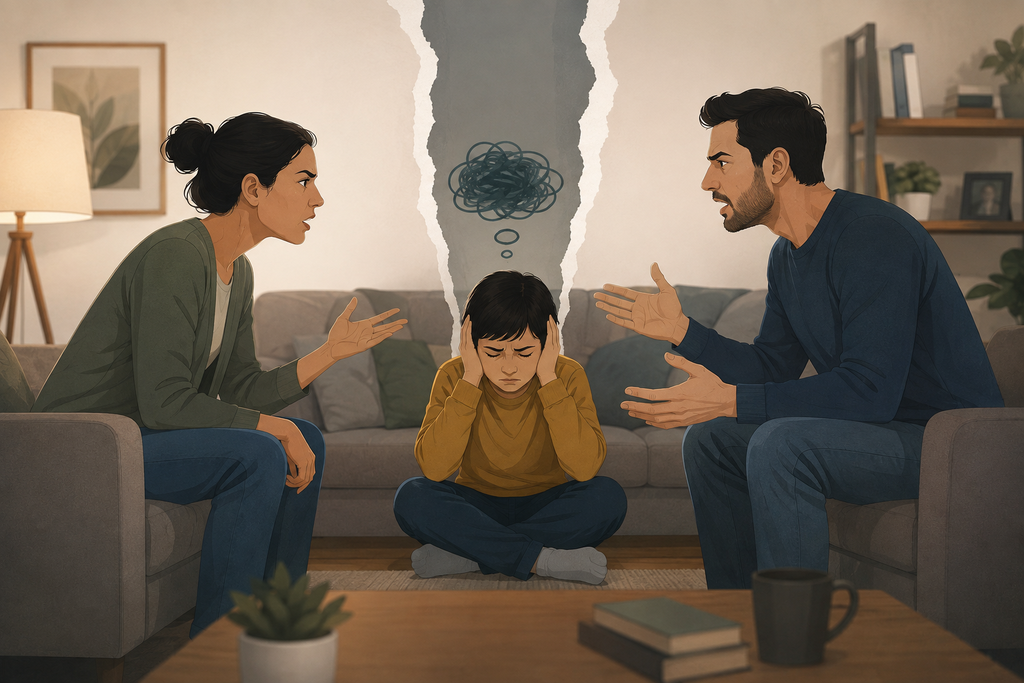
They were trying to protect the same child
Rhea believed children needed structure.
If expectations were clear, she thought, children would learn responsibility. Sometimes saying no was part of being a parent.
Sarmad saw things differently.
He worried that too much pressure would make their son afraid of making mistakes. He wanted him to have space to become independent and learn from his own decisions.
Neither position felt unreasonable to the person holding it.
That was what made their disagreements difficult.
They were not arguing because one of them cared and the other did not.
They were arguing because both cared, but their ideas about what care required were different.
The disagreement rarely stayed about the child
The next morning, their son asked for his tablet.
Rhea said no until his schoolwork was finished.
Sarmad looked at her.
“He finished what you asked him to do yesterday.”
“He left the assignment incomplete.”
“He’ll do it after breakfast.”
“He needs to learn that there are consequences.”
Their son stood nearby, listening.
He said nothing.
Eventually he went to his room.
The discussion continued.
“You always make me look like the strict one.”
“Because you always change the rules.”
“I don’t change the rules.”
“You do when he’s upset.”
“And you never notice how much pressure you’re putting on him.”
The child was no longer the subject of the conversation.
He had become the place where something else was happening.
When parents start arguing about each other
After their son left the room, neither parent felt understood.
Rhea felt that she was carrying the responsibility for discipline.
Sarmad felt that his concern for their son’s emotional wellbeing was being dismissed.
The original question is Should he finish the work before using the tablet?—had almost disappeared.
Now there were larger questions underneath it.
Do you trust my judgement?
Do you think I’m too strict?
Do you think I’m not responsible enough?
Are we actually parenting together?
The disagreement had moved from a parenting decision to the relationship between the parents.
And once that happened, the next disagreement became easier to trigger.
Their child noticed the difference
Children do not need to understand every argument to notice that something is happening.
Their son began watching before asking.
Who was going to answer?
Which parent was more likely to say yes?
Could he ask one parent after the other had already said no?
Sometimes he did not even need to ask.
He could sense when the answer might change.
Neither parent intended to put him in the middle.
But the difference between them was becoming something he had learned to navigate.
The problem was not that they disagreed
Rhea and Sarmad were never going to agree about everything.
They came from different families.
They had grown up with different expectations.
They had different memories of what helped them as children and what had hurt them.
They had different ideas about independence, discipline, achievement and protection.
Their child was also changing.
What had worked when he was eight did not necessarily work now that he was twelve.
So disagreement itself was not unusual.
The more important question was:
What happened between them when they disagreed?
Could they discuss the difference?
Or did one feel criticised?
Did the other become defensive?
Did one withdraw?
Did they change the decision in front of the child?
Did the disagreement remain between the parents, or did the child gradually become part of it?
The difference and the pattern are not the same thing
The difference between them was real.
Rhea was worried that their son was beginning to avoid difficult tasks. Sarmad was worried that he was becoming anxious whenever schoolwork was mentioned.
Neither concern cancelled the other.
They could still disagree about what their son needed.
The more important question was what happened when those different concerns met.
The difference remained.
But the pattern around the difference could change.
What happens between the parents matters to the child
What matters is not that parents never disagree.
It is what happens around the disagreement whether the child becomes caught between them, whether the parents can return to a shared understanding, and whether there is a way back after things go wrong.
Families will not always get this right.
Sometimes the first question is not “How should we parent?”
It may be:
“What happens between us when we disagree about our child?”
That question can reveal something neither parent had been looking at.
Perhaps one parent feels alone with responsibility.
Perhaps the other feels constantly criticised.
Perhaps both are frightened of making the wrong decision.
Perhaps an old disagreement from their own childhood is quietly influencing what they expect from their child.
Or perhaps the child has simply reached a new stage, and the parents have not yet found a new way of working together.
The disagreement may be real.
But the pattern surrounding it may be something else.
Seeing the pattern can change the conversation
Rhea eventually noticed something.
Whenever Sarmad softened a rule, she became stricter.
Whenever she became stricter, Sarmad became more protective.
The more protective he became, the more alone she felt with responsibility.
The more alone she felt, the harder she pushed.
They had both been responding to the other.
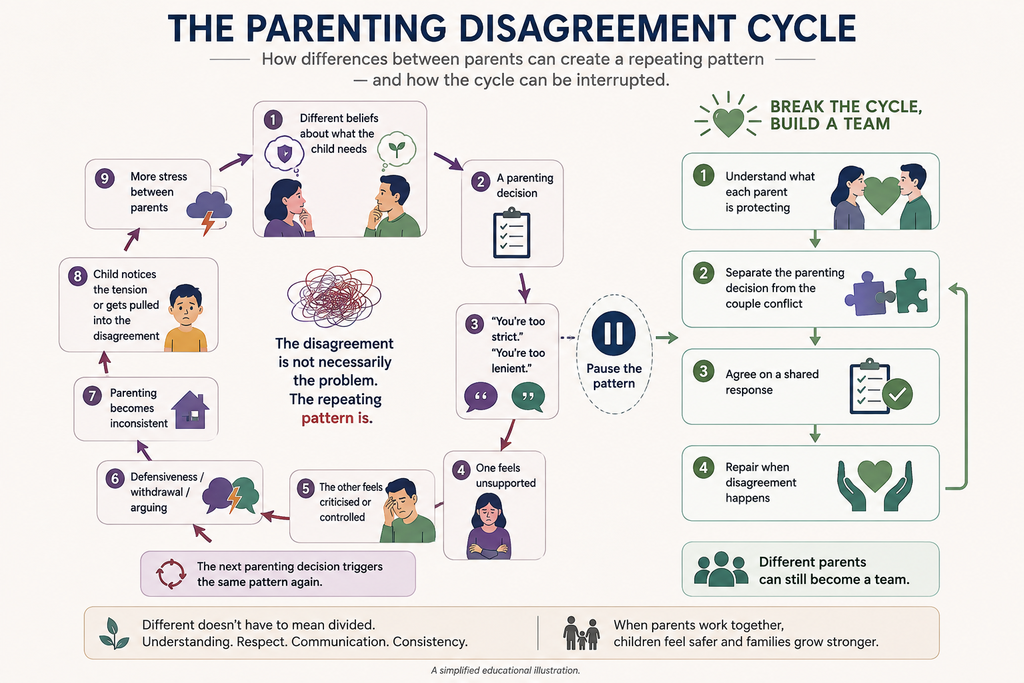
The Parenting Disagreement Cycle shows how differences between parents do not necessarily create the problem the repeating pattern around those differences can.
Parents may begin with different beliefs about what their child needs. A parenting decision can then lead to criticism, feelings of being unsupported or controlled, defensiveness or withdrawal, and inconsistent responses. The child may notice the tension or feel caught between the parents, adding further stress and making the next disagreement more likely.
The second part of the image shows how the cycle can be interrupted: understand what each parent is protecting, separate the parenting decision from the couple conflict, agree on a shared response, and repair disagreements when they happen.
Neither had intended to create the pattern.
Yet both had become part of it.
That did not answer every parenting question.
It gave them a different question to work with.
A psychologist might look beyond the immediate disagreement
A conversation about parenting may not begin by deciding which parent has the better approach.
It may begin by understanding the family situation.
What is happening with the child?
What are each of the parents noticing?
What concerns are they carrying?
What expectations do they have?
How do they respond when they disagree?
What does the child experience when those disagreements happen?
And what happens afterwards?
Sometimes the useful work is not about finding one perfect parenting method.
It is about helping the people involved understand each other well enough to make decisions together.
The next evening
The school notebook was on the table again.
Rhea looked at it.
Sarmad looked at her.
For a moment, both seemed ready to begin the same argument.
Then Sarmad said:
“I think we’re about to do that thing again.”
Rhea smiled slightly.
“What thing?”
“The thing where you think I’m being too easy and I think you’re being too strict.”
She looked at him.
“Maybe.”
There was still a disagreement.
But this time, they could see it coming.
And sometimes seeing the pattern before it takes over is where a different conversation begins.
A different way of looking at the situation
The question is not always:
“Which parent is right?”
Sometimes it is:
“What happens between us when we disagree?”
The difference in parenting may be real.
The concerns may be real.
The child may genuinely need something different.
But the way parents respond to one another can become part of the family situation too.
Understanding that does not make the disagreement disappear.
It gives the family another place from which to approach it.
If this feels familiar
Perhaps your disagreements are about homework.
Perhaps they are about screen time, friends, discipline, independence, school, routines or expectations.
Perhaps you agree about what you want for your child but keep disagreeing about how to get there.
Or perhaps the disagreement has begun to affect the relationship between you.
You do not have to decide which parent is right before beginning a conversation.
Sometimes it is enough to ask:
“What keeps happening between us when we disagree about our child?”
What might be useful next?
If you want to understand difficulties around parenting, family relationships and communication, you can explore the relevant Family Mediation Counselling support at Chromfinite.
Explore Family Mediation Counselling →
You can also explore the psychologist whose work includes relationships, parenting and family concerns:
Meet Vamsy Krishna D →
If you are not sure what kind of support would be appropriate, you can use Pathfinder to explore where you might begin.
Explore Pathfinder →
Or, if you already know you would like to talk:
Request a Counselling Session →
About this Case Room
This is a fictional, composite educational scenario created by Chromfinite. It does not describe an actual Chromfinite client or a specific real relationship.
The purpose is to explore a human situation and the kinds of questions that may be useful in understanding it. It is not a diagnosis, psychological assessment or treatment recommendation.
Article information

Author: V V N VAMSY KRISHNA DAMISETTI
Qualification: MSc., MA., LLB
Professional role: PSYCHOLOGIST & DIRECTOR
Reviewed by: K L NIHARIKA (MA, MSc, LLB)
Last reviewed: 01-06-2025