Everything Changed After They Left
A fictional situation about grief, loss and learning to live with what has changed.
Ravi still had his mother’s number saved in his phone.
He knew there was no reason to delete it.
There was no call he could make. No message that would receive a reply. Yet whenever he opened his contacts, her name was still there, exactly where it had always been.
One evening, while putting away some groceries, he noticed the tea she used to drink.
For a moment, he thought about buying it.
Then he remembered.
He stood in the kitchen for a while, holding the packet.
Nothing dramatic had happened.
There was no new news. No sudden reminder that changed anything.
She was simply not there.
And that was the difficult part.
Life had continued
Ravi had returned to work.
He answered messages. He met people. He occasionally laughed at something someone said.
From the outside, things probably looked better.
But ordinary life had acquired small interruptions.
A song.
A familiar smell.
A chair that remained empty.
Something he wanted to tell her before remembering that he could not.
The moments did not arrive according to a schedule.
Some days passed quietly.
Other days seemed to contain her everywhere.
“I thought I was doing better.”
One afternoon, Ravi was talking to a friend.
“I don’t understand,” he said. “Last week I was fine.”
His friend paused.
“You seemed fine.”
Ravi smiled.
“I was.”
Neither of them knew what else to say.
The conversation moved somewhere else.
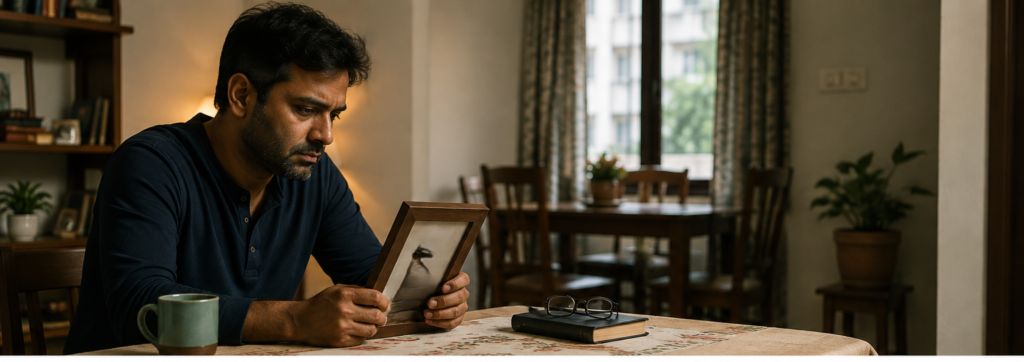
That evening, Ravi came home and found himself looking at his mother’s old photograph.
He wondered whether he was supposed to be moving on.
He also wondered what moving on was supposed to mean.
When everyone else seems to move forward
The world does not stop because someone is missing.
Work continues.
Birthdays arrive.
People make plans.
Families gather.
Friends talk about holidays and ordinary problems.
Sometimes someone asks:
“Are you feeling better now?”
The question may come from kindness.
But Ravi did not know what answer they were expecting.
Was he better because he had gone back to work?
Was he worse because he still missed her?
Could both be true?
Perhaps grief was not a road where one simply travelled from sadness to happiness.
Perhaps life was becoming something else while he was still learning how to live inside it.
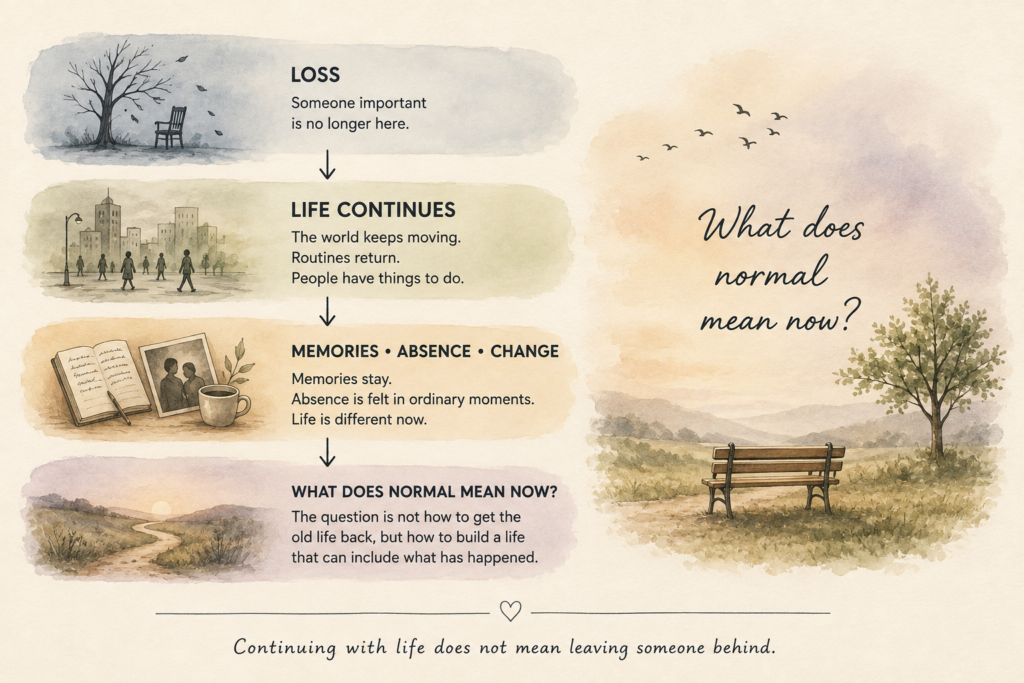
What does “normal” mean now?
Ravi had spent months waiting to feel like himself again.
But there was a problem with that idea.
The life he wanted to return to no longer existed in exactly the same form.
His mother was part of that life.
Her absence had changed ordinary things.
Meals were different.
Certain festivals were different.
Some conversations existed only in memory.
Even good days could contain a quiet awareness that someone was missing.
Eventually, the question changed.
It was no longer:
“When will I get back to normal?”
It became:
“What does normal mean now?”
The person is gone. But the relationship remains.
This can be one of the strange things about losing someone.
The relationship does not disappear at the same moment as the person.
Memories remain.
Habits remain.
Things they taught us remain.
There may be words we still hear in their voice.
There may be moments when we instinctively want to tell them something.
Ravi could no longer speak to his mother.
But his relationship with her had shaped a part of the person he had become.
The loss had changed that relationship.
It had not made it meaningless.
Grief does not always look like grief
Grief does not always look like grief
Sometimes it is obvious. Someone cries, withdraws, or cannot concentrate.
Sometimes it looks much more ordinary.
A person goes to work and feels fine until lunch.
Someone avoids a familiar place because it contains too many memories.
Someone laughs with friends and feels guilty afterwards.
Someone keeps an old number because deleting it feels strangely final.
Loss does not arrive in one predictable form.
What happens when life continues?
Ravi eventually began to notice something.
He had been treating “moving forward” and “leaving behind” as though they were the same thing.
They were not.
He could build a life that contained new experiences without pretending the old ones had never mattered.
He could laugh without proving that he had forgotten.
He could miss his mother without needing every day to feel like the day she died.
Nothing about that made the loss smaller.
It simply made room for another possibility:
Perhaps continuing with life does not mean leaving someone behind.
A psychologist might begin somewhere different
A conversation about loss does not necessarily begin with the question:
“How do I stop feeling this way?”
It may begin with understanding what has changed.
What does the absence mean in everyday life?
What memories have become difficult?
What parts of life feel different now?
What does the person miss most?
What has become harder?
What has remained?
And perhaps, gradually, what does it mean to build a life that includes the loss rather than pretending the loss did not happen?
The purpose is not to erase the relationship.
It is to understand what the relationship, the loss and the life that remains now mean to the person.
Sometimes the hardest part is not forgetting
It is learning that remembering and continuing can exist together.
Ravi still had his mother’s number in his phone.
Months later, he still had not deleted it.
One morning he noticed it again.
For the first time, he did not feel that he needed to decide whether keeping it meant he was stuck.
It was simply there.
A small record of someone who had been part of his life.
He put the phone down and went to make tea.
The day continued.
She was still gone.
And he was still living.
Both things could be true.
If this feels familiar
Perhaps your experience is not exactly like Ravi’s.
Maybe someone important has died.
Maybe a relationship has ended.
Maybe someone has left your life in another way.
Perhaps you are functioning again, but ordinary things still bring the absence back. Perhaps other people seem ready to move forward while part of you is still trying to understand what has changed.
You do not have to explain your experience in exactly the right words before beginning a conversation.
Sometimes it is enough to start with:
“Something changed, and I’m still trying to understand how to live with it.”
What might be useful next?
If you would like to explore how Chromfinite approaches support around loss and change:
Explore Grief Counselling →
You can also meet the psychologist who offers this area of support:
Meet Vamsy Krishna D →
If you are not sure what kind of support would be appropriate, you can use Pathfinder to explore where you might begin.
Explore Pathfinder →
Or, if you already know you would like to talk:
Request a Counselling Session →
About this Case Room
This is a fictional, composite educational scenario created by Chromfinite. It does not describe an actual Chromfinite client or a specific real relationship.
The purpose is to explore a human situation and the kinds of questions that may be useful in understanding it. It is not a diagnosis, psychological assessment or treatment recommendation.
Article information

Author: V V N VAMSY KRISHNA DAMISETTI
Qualification: MSc., MA., LLB
Professional role: PSYCHOLOGIST & DIRECTOR
Reviewed by: K L NIHARIKA (MA, MSc, LLB)
Last reviewed: 01-06-2026