
We Keep Having the Same Fight
A fictional relationship situation about conflict, communication and repeating patterns.
Kiran noticed that Noor had seen the message.
There was nothing unusual about the message itself. It was a simple question about dinner.
Noor had opened it. Then the phone went quiet.
A few minutes passed.
Kiran checked again.
Still nothing.
By the time Noor came home, Kiran had already imagined several explanations.
“Why didn’t you reply?”
Noor looked tired.
“I was busy.”
“You could have just said that.”
“I said I was busy.”
The conversation should have ended there.
It didn’t.
Kiran asked another question. Noor became irritated. Kiran felt that Noor was avoiding the real issue. Noor felt that another ordinary evening was becoming another interrogation.
Within a few minutes, they were no longer talking about dinner.
They were talking about all the other times this had happened.
And then, as often happened, Noor stopped talking.
Kiran became more frustrated.
The silence felt like confirmation that something was wrong.
Noor experienced the continued questions differently. The more Kiran asked, the more pressured Noor felt. The more pressured Noor felt, the more Noor wanted to withdraw.
Neither of them was trying to make the evening worse.
Yet somehow, both were helping it become worse.
It wasn’t always like this
There had been a time when Kiran’s questions felt like care.
Noor’s quietness had once felt comfortable.
They could spend an evening together without needing to explain every pause, every expression, every unanswered message.
Somewhere along the way, something had changed.
Perhaps it had happened slowly enough that neither of them noticed.
A question became a concern.
A concern became a demand for reassurance.
The reassurance did not feel reassuring.
An explanation sounded defensive.
Silence felt like rejection.
And the next conversation began with the unfinished feeling of the previous one.
The same argument, with different words
A week later, it happened again.
This time it was about plans for the weekend.
Kiran wanted to know what Noor had decided.
Noor wanted some time to think.
Kiran heard hesitation.
Noor heard pressure.
The words were different this time.
The feeling was not.
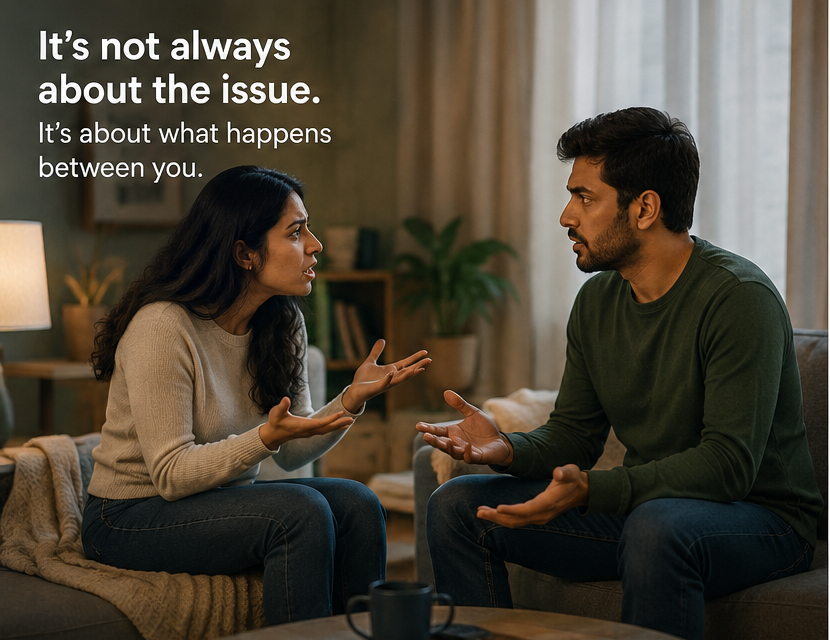
And afterwards, both of them remembered the argument differently.
Kiran remembered trying to get a straight answer.
Noor remembered being unable to answer without making things worse.
Both memories were true.
That was part of the difficulty.
When the pattern becomes bigger than the argument
There comes a point in some relationships when the original subject almost becomes irrelevant.
The argument may begin with a message, a plan, money, family, household work, or something that happened during the day.
But underneath it, something familiar has already begun.
One person feels uncertain and reaches for reassurance.
The other experiences the questioning as pressure and pulls away.
The withdrawal creates more uncertainty.
The uncertainty leads to more questions.
The questions create more pressure.
And the cycle starts again.
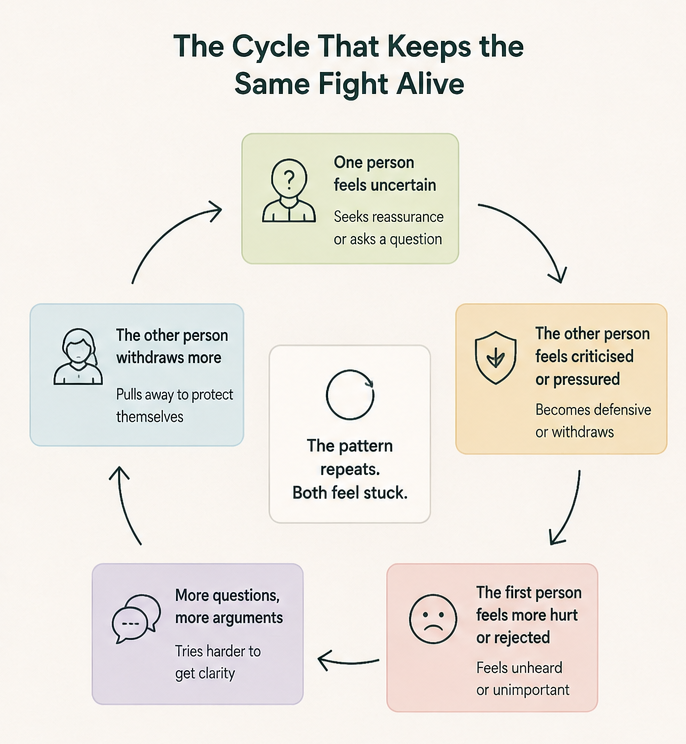
By then, neither person is simply responding to the present moment.
Both are responding to what they have learned to expect from the other.
What happens between two people matters too
It is easy to look at a difficult relationship and ask:
Who is causing the problem?
Sometimes that question is understandable.
It can also be limiting.
Kiran could point to Noor’s silence.
Noor could point to Kiran’s questioning.
Each could produce a convincing explanation.
But there was another question they had not been asking:
What happens between us once this begins?
That question changes the view.
The problem is no longer simply Kiran’s questions or Noor’s silence.
It is the sequence connecting them.
And once that sequence becomes familiar, it can begin to feel almost automatic.
Understanding the pattern does not mean deciding who is right
A repeating pattern does not mean that both people have behaved in exactly the same way.
It does not mean that every relationship problem is equally shared.
And it does not mean that difficult or harmful behaviour should simply be accepted.
It means that sometimes there is something happening between people that is worth understanding alongside what each person is doing individually.
A psychologist might therefore explore more than the argument itself.
What happened immediately before it?
What did each person think was happening?
What was each person trying to communicate?
What did each person experience when the other responded?
And what usually happens next?
These questions can move a conversation away from proving who was right and towards understanding the pattern that keeps bringing the same problem back.
Sometimes the first change is simply seeing it
Imagine Kiran noticing the moment when the cycle begins.
The unanswered message arrives.
The familiar uncertainty appears.
The first question forms.
But this time, Kiran recognises something else too.
Not just:
“Noor isn’t replying.”
But:
“I know what usually happens next.”
And imagine Noor recognising the other side.
Not simply:
“Kiran is questioning me again.”
But:
“I know what happens when I shut down.”
Nothing has been solved yet.
No argument has magically disappeared.
But something has changed.
The pattern that once seemed like a series of unrelated arguments has become visible.
And what can be seen can sometimes be approached differently.
A different way of looking at the same situation
The question may not always be:
“Who started the fight?”
It may sometimes be:
“What keeps happening between us after the first moment?”
That does not erase individual responsibility.
It simply gives the relationship another place from which to understand what is happening.
If this feels familiar
You may not have the same arguments as Kiran and Noor.
Perhaps yours begin with unanswered messages.
Perhaps they begin with money, family, parenting, work, intimacy, household responsibilities, or something that seems almost too small to explain why the argument became so large.
What may be familiar is the feeling of ending up in the same place.
You say something.
The other person reacts.
You react to that reaction.
The conversation changes direction.
And later, both of you wonder how you got there again.
Sometimes the useful question is not whether the original disagreement was important.
It is whether there is a pattern underneath it that both people have stopped noticing.
What might be useful next?
If you recognise something in this situation, you can explore Couple Mediation Counselling at Chromfinite to understand how the service approaches relationship difficulties and repeating patterns.
Explore Couple Mediation Counselling →
You can also meet the psychologist who offers this area of support:
Meet Vamsy Krishna D →
If you are not sure what kind of support would be appropriate, you can use Pathfinder to explore where you might begin.
Explore Pathfinder →
Or, if you already know you would like to talk:
Request a Counselling Session →
About this Case Room
This is a fictional, composite educational scenario created by Chromfinite. It does not describe an actual Chromfinite client or a specific real relationship.
The purpose is to explore a human situation and the kinds of questions that may be useful in understanding it. It is not a diagnosis, psychological assessment or treatment recommendation.
Article information

Author: V V N VAMSY KRISHNA DAMISETTI
Qualification: MSc., MA., LLB
Professional role: PSYCHOLOGIST & DIRECTOR
Reviewed by: K L NIHARIKA (MA, MSc, LLB)
Last reviewed: 01-09-2025